POSTED
October 27, 2026
IRR and what it means to you

What is IRR? Internal Rate of Return, or IRR, is an annualized measure of investment performance that accounts for the timing of cash inflows and outflows. Because the timing of cash flows can affect the result, IRR can be useful for understanding an investment’s expected performance over time. It is one measure of performance and […]

What is IRR?
Internal Rate of Return, or IRR, is an annualized measure of investment performance that accounts for the timing of cash inflows and outflows. Because the timing of cash flows can affect the result, IRR can be useful for understanding an investment’s expected performance over time. It is one measure of performance and should be considered alongside the broader investment details and risks.
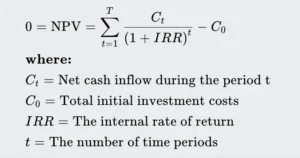
IRR Formula.
Credit: Investopedia
Why We Use IRR
Solar development can take time. Projects need to be originated, evaluated, and advanced before they are ready for construction or a potential sale. As a result, invested capital may remain committed and illiquid for several years. Shasta’s strategy is to pursue the sale or co-development of projects within a three-to-six-year horizon, with a focus on partnering with independent power producers (IPPs) or utilities that can finance and build large-scale solar projects. This is a target strategy, not a guaranteed timeline or outcome.
We evaluate promising utility-scale solar, battery storage, and other advanced renewable energy sites with suitable land and existing interconnection infrastructure. Our work includes substation studies, land analysis, utility queue assessments, and market analysis.
Our goal is to advance the four to seven most promising project areas, targeting approximately 1,500 MW of solar photovoltaic capacity with energy storage across roughly 10,000 acres.
Given the expected development timeline, IRR can help describe how the timing of projected cash flows affects an investment’s annualized return. Because IRR is based on the cash flows and assumptions used in its calculation, it may not capture the full picture on its own, and actual results may differ from projections.
A return multiple offers another way to describe investment performance: it shows the total amount returned compared with the amount invested, including the original investment. For example, a hypothetical $10,000 investment returning $20,000 produces a 2x return multiple, meaning investors receive their original capital plus an equal amount in profit. If that entire payment arrives after five years, with no interim distributions, the IRR is approximately 14.9%. Both figures describe the same outcome, but the multiple shows the total return while IRR accounts for how long it takes to receive it.
For investors interested in exploring how utility-scale solar can provide direct, measurable environmental impact alongside financial returns, connect with Shasta Power to learn more about opportunities in solar project development.